


Most North Carolina homeowners assume roofing lingo is just contractor jargon, but much of it is directly tied to state building codes and affects what is legally required during installations, repairs, and inspections. That surprising overlap means misunderstanding a term like “underlayment” or “flashing” is not just a vocabulary issue. It can slow down an insurance claim, delay a repair, or leave you confused when reviewing a contractor quote. This guide will walk you through the essential roofing terms, explain how they connect to North Carolina regulations, and give you the confidence to have clear, productive conversations with any roofing professional.
Table of Contents
- Why roofing terminology matters in North Carolina
- Core roofing terms every homeowner should know
- Common pitfalls: What most homeowners miss when talking roofing
- Applying roofing terminology: From discussion to decision
- The uncomfortable truth: Most roofing confusion starts at the contract
- Need more help? Connect with North Carolina roofing experts
- Frequently asked questions
Key Takeaways
| Point | Details |
|---|---|
| State code shapes terminology | Roofing terms in North Carolina are tied to legal requirements for installation and inspection. |
| Clear vocabulary speeds repairs | Knowing key terms helps you avoid costly misunderstandings and delays with contractors. |
| Common pitfalls are preventable | Asking for code references and clarifying definitions can safeguard your investment. |
| Terminology helps insurance claims | Insurance documents require proper terminology to speed up claims and prevent rejections. |
| Expert support is available | Local roofing professionals can guide you through terminology and ensure code compliance. |
Why roofing terminology matters in North Carolina
Before jumping into specific terms, let’s clarify why accurate roofing language is so important to your NC home. North Carolina follows a state building code that governs everything from how shingles are fastened to how water drainage systems are installed. When contractors, inspectors, and insurance adjusters talk about your roof, they are often using language pulled directly from those code documents.
Roofing terminology in NC is shaped by state code requirements, meaning terms like “underlayment,” “fastener,” and “flashing” connect directly to inspection and legal standards. That is not just industry shorthand. Those words define specific materials, methods, and installation requirements that must meet code to pass inspection.
Understanding these terms helps you in more situations than you might expect:
- Getting accurate estimates: Contractors who know you understand the terms are less likely to use vague language that leads to scope creep or unexpected charges.
- Passing inspections: If your contractor installs the wrong type of underlayment or uses insufficient fasteners, the work may fail inspection. Knowing what to ask prevents that.
- Filing insurance claims: When you file roof damage claims, the documentation needs to match what adjusters and inspectors look for. Correct terminology strengthens your case.
- Reviewing contractor proposals: A well-informed homeowner can spot missing items or vague descriptions in a proposal and ask for clarification before signing.
- Avoiding post-work disputes: If a contract says “standard installation” without defining the method or materials, you may have little recourse if the result does not meet your expectations.
“Miscommunication during roofing projects is one of the most common causes of delays and rework. Homeowners who speak the same language as their contractor reduce back-and-forth significantly and get better outcomes.”
When you visit our roofing FAQ page, you will find many of the questions homeowners ask most often are rooted in terminology confusion. The good news is that a little preparation goes a long way.
Core roofing terms every homeowner should know
Now that we have established why terminology matters, let’s break down the most important terms you will encounter when dealing with any roofing project in North Carolina.
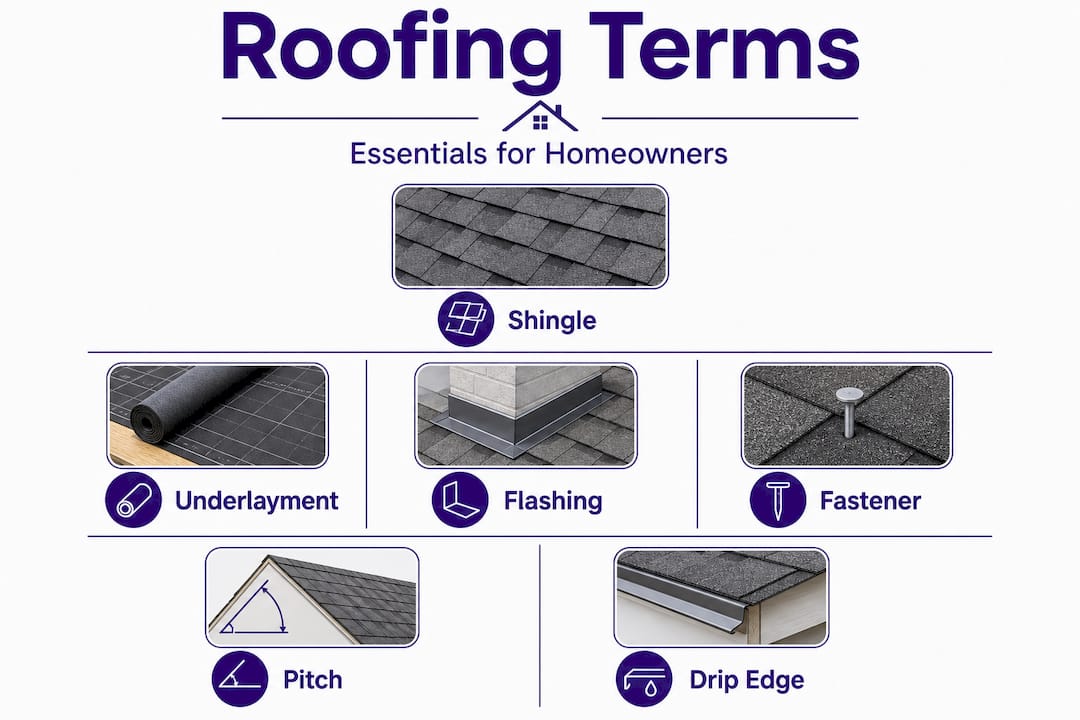
| Term | Definition | Why it matters |
|---|---|---|
| Shingle | The overlapping panels, usually asphalt, that form the outermost layer of your roof | Shingle type, grade, and warranty affect cost and lifespan |
| Underlayment | A water-resistant layer installed between the roof deck and shingles | Required by NC code; acts as a secondary moisture barrier |
| Flashing | Metal pieces used to seal joints and transitions, like around chimneys and skylights | Prevents water from entering at vulnerable points |
| Ridge | The peak where two roof slopes meet at the top | Ridge caps and ventilation components are installed here |
| Pitch | The slope of your roof, expressed as a ratio of rise to run | Affects drainage, material choice, and labor complexity |
| Fastener | Nails or screws used to secure shingles and underlayment | NC code specifies type, length, and spacing requirements |
| Drip edge | A metal strip installed along roof edges to direct water away from the fascia | Protects the wood fascia board from rot and water damage |
| Valley | The angle formed where two roof planes meet at a downward slope | A critical drainage point prone to leaks if improperly sealed |
State code includes fastener, underlayment, and flashing requirements, so understanding these terms is essential for any conversation with your contractor or inspector. If a contractor uses a term you do not recognize, do not let it pass.
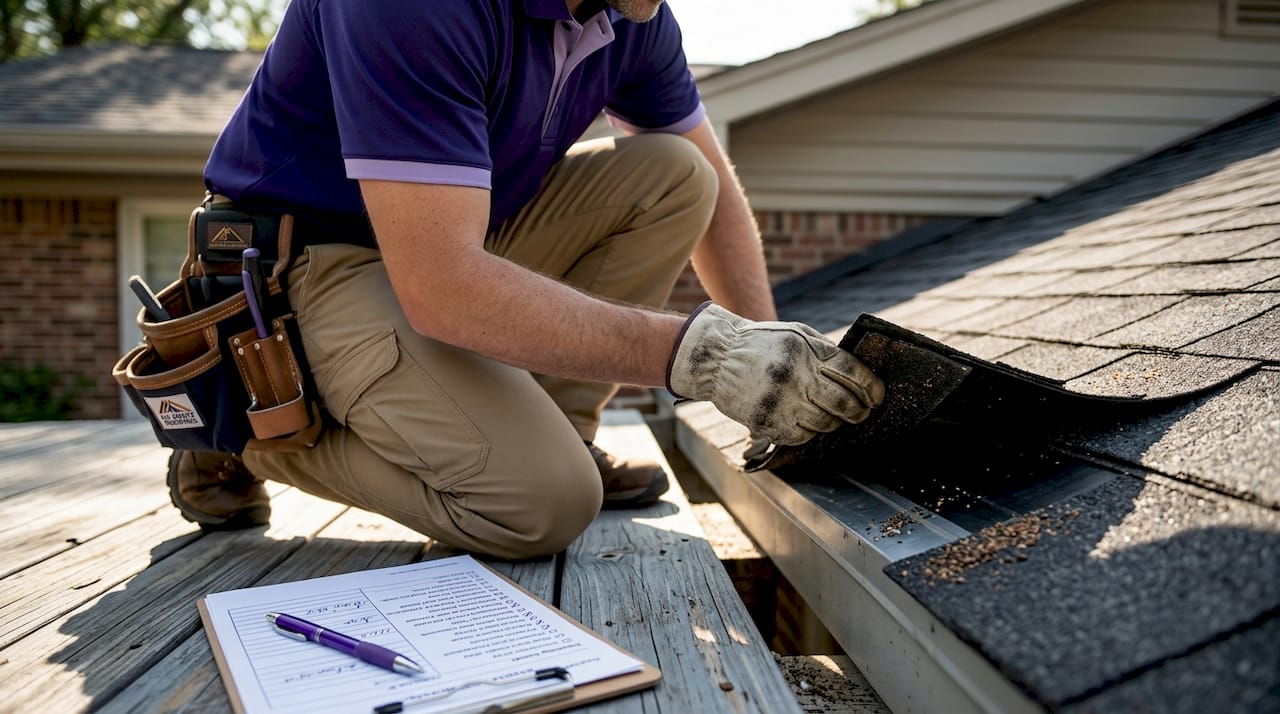
Several of these terms will also appear on insurance documents and inspection checklists. The hail damage checklist that adjusters commonly use, for example, references shingle bruising, flashing displacement, and drip edge integrity. If you know what those mean, you can review the findings yourself and ask better questions.
Terms that are most likely to appear in contractor quotes include:
- Square: A unit of measurement equal to 100 square feet of roof area. Quotes are usually priced per square.
- Decking (or roof deck): The plywood or OSB panel layer beneath the underlayment. Damaged decking often adds to replacement costs.
- Ice and water shield: A self-adhering membrane used in valleys and low-slope areas for extra protection, often required by code in certain NC climates.
- Soffit and fascia: The boards running along the eaves and underside of the roof overhang. These are connected to but separate from the roofing system.
Reviewing our roofing blog gives you access to deeper explanations of many of these terms with real-world photos and local context. Knowing this vocabulary before your first contractor conversation puts you in a much stronger position. Our roof maintenance page also explains how these components are checked during routine upkeep.
Pro Tip: Before signing any contract, circle every term you are unsure about and ask your contractor to define it in writing. A trustworthy contractor will not hesitate to clarify. If they resist, that tells you something important.
Common pitfalls: What most homeowners miss when talking roofing
Knowing terms is one thing, but avoiding mistakes is just as important. Here is what most people miss when navigating roofing projects in North Carolina.
-
Assuming “standard installation” is good enough. Many homeowner contracts include vague language like “standard installation” without specifying fastener type, spacing, or underlayment grade. Fastening requirements can be mandatory rather than optional in certain NC regions, especially near coastal or storm-prone areas. If the contract does not spell it out, ask for it in writing.
-
Confusing repair and replacement terms. A “repair” typically addresses isolated damage to specific components. A “replacement” involves removing and reinstalling the full roofing system. Insurance adjusters use these terms very differently when determining payout. The insurance roof claims guide breaks down how this distinction directly affects your settlement.
-
Overlooking inspection language. During a professional roof inspection, the inspector may note items like “inadequate fastening,” “improper flashing,” or “exposed underlayment.” These phrases carry specific code implications. If you do not understand them, you might not realize the urgency of the issue or the cost to correct it.
-
Mixing up product warranties with workmanship warranties. Shingle manufacturers offer product warranties covering material defects. Roofing contractors offer workmanship warranties covering installation quality. These are entirely separate, and most homeowners do not realize that installation errors void the product warranty.
-
Accepting estimates without material specifications. An estimate that says “install new shingles” without noting the brand, weight class (e.g., architectural vs. 3-tab), or fastener requirement leaves too much room for downgrading materials on the job. Specific material language protects you.
You will find deeper discussion of many of these issues on our roofing blog, where we regularly cover what to watch for when reviewing roofing proposals and inspection reports.
Pro Tip: Ask your contractor to include specific code references in their proposal, such as the applicable North Carolina building code section for underlayment or fastener requirements. Contractors who follow code closely should have no problem providing this. It also protects you legally if work needs to be corrected later.
Applying roofing terminology: From discussion to decision
Now, let’s take what you have learned and show how to use these terms effectively in real conversations and contracts. Knowing vocabulary is only useful if you apply it at the right moments.
When you are getting contractor quotes, come prepared with specific questions:
- “What type and grade of underlayment will you use, and does it meet NC code for my roof pitch?”
- “How many fasteners per shingle are you applying, and what is the nail pattern?”
- “Will new flashing be installed around the chimney and valleys, or will existing flashing be reused?”
- “Is drip edge included, and where will it be installed?”
- “What is the decking condition, and how will you handle damaged sections found during tear-off?”
These questions show contractors you are paying attention. They often result in more detailed, accurate proposals. As noted in NC roofing guidelines, fastening and related requirements can be mandatory in certain regions, so confirming compliance upfront protects your investment.
Here is a comparison of how the same concepts are described differently in contractor contracts versus inspection reports:
| Concept | Contractor contract language | Inspection report language |
|---|---|---|
| Nail pattern | “6-nail fastening per shingle” | “Inadequate fastener spacing noted” |
| Flashing | “Install new metal flashing at transitions” | “Flashing failure at chimney base” |
| Underlayment | “30 lb felt or synthetic equivalent” | “Missing underlayment in valley area” |
| Drip edge | “Install aluminum drip edge at eaves” | “Drip edge absent along north slope” |
| Decking | “Replace any damaged plywood decking” | “Soft decking detected; structural review recommended” |
Seeing both columns makes clear why terminology consistency matters. When you repair roof leaks, an inspection report describing “flashing failure” should match a repair proposal that specifically addresses flashing replacement. If those two documents use completely different language, there is a risk the issue will not be fully addressed.
When reviewing insurance claim statements, look for these key questions:
- Does the adjuster’s report use the same terms as your contractor’s proposal?
- Are specific components like underlayment, flashing, and fasteners listed individually or lumped together?
- Is the repair or replacement scope clearly defined?
For a deeper look at how adjusters approach these conversations, the insurance claim negotiations resource explains the typical back and forth between homeowners, contractors, and insurance companies. Understanding how each party uses roofing terminology can prevent a claim from being underpaid.
The uncomfortable truth: Most roofing confusion starts at the contract
Here is our candid take after working with homeowners across Burlington, Greensboro, Mebane, and communities throughout North Carolina. Most homeowners spend their energy worrying about product quality or brand names when the real source of confusion and cost is the contract itself.
Roofing products are fairly standardized. Reputable shingle brands all meet basic performance standards. But contracts? They vary dramatically. We have seen proposals use the term “flash as needed,” which tells you nothing about where flashing will go, what type it will be, or whether it will meet code. We have seen contracts reference “code-compliant installation” without specifying which code or what version. Those gaps are not accidents. They leave room for shortcuts.
Building code terms in contracts are non-negotiable once work begins. If the contract says “standard fastening” but the NC building code requires a specific six-nail pattern for your wind zone, and your contractor used four nails, you have a problem. The work may fail inspection. You may need it redone. And if the contract was vague, proving the contractor deviated from your agreement becomes very difficult.
Here is the practical wisdom we share with every homeowner we work with: homeowners who ask for specific code references in writing before the work starts have dramatically fewer disputes after the work is done. It is that simple. Our roofing blog regularly covers how to read and interpret roofing contracts so you can walk into any project with your eyes open.
The goal is not to become a roofing expert. The goal is to know enough to ask the right questions and recognize when answers are too vague to protect you.
Need more help? Connect with North Carolina roofing experts
If you are ready to apply your knowledge or have specific roofing needs, local expertise is just a click away. At All About Roofing Co., LLC, we work with homeowners across North Carolina every day, and we know how important it is for you to feel informed and confident before any work begins.
Whether you need a full roof replacement, targeted roof repairs after storm damage, or a thorough roof inspection to understand your current roof’s condition, we are here to walk you through every detail. We use plain language, reference applicable code when relevant, and make sure you understand exactly what is being done and why. Serving Burlington, Greensboro, Mebane, Chapel Hill, Hillsborough, and surrounding communities, we are your trusted local partner for every roofing need. Reach out today for a free estimate and let’s start with a conversation you actually feel good about.
Frequently asked questions
What are the most important roofing terms for NC homeowners?
Key terms include underlayment, flashing, fastener, shingle, pitch, and drip edge, all of which are regulated by state code and used consistently by contractors and inspectors throughout North Carolina.
How does code terminology affect my roof installation?
State code terms like fasteners and underlayment define the exact materials and methods required, meaning your installation must meet those standards to pass inspection and maintain any applicable warranty.
Can misunderstanding roofing terminology impact my insurance claim?
Yes. Incorrect or mismatched terms on repair or inspection documents can delay processing or reduce your payout, since accurate terminology is what adjusters use to verify and approve covered damage.
Where can I find a full glossary of roofing terms?
Local contractors and detailed roofing blogs often provide glossaries tailored to North Carolina homeowners, covering both technical definitions and how each term connects to state code and insurance requirements.
